
 Posted by
 Putin reminds everyone that Ukraine joining NATO could lead to nuclear war
By Sarah Starkey | February 11, 2022
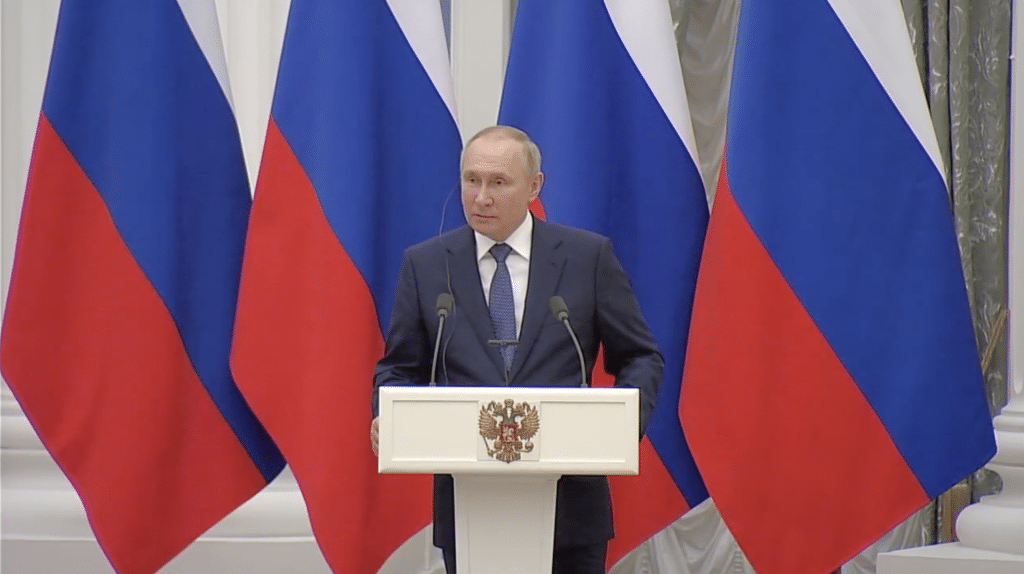 Russian President Vladimir Putin speaks during a joint press conference with the President of France, Emmanuel Macron.
On Feb. 8, in a jarring answer to a question from the media, Russian President Vladimir Putin said allowing Ukraine to join NATO would increase the prospects of a Russia-NATO conflict that could turn nuclear. Putin’s assertion, made in the context of a complicated hypothetical about an unlikely Ukrainian attempt to take Crimea back from Russia, came during a joint press conference with the President of France, Emmanuel Macron.
With over 100,000 Russian troops amassed at Ukraine’s border, the conference was originally called to discuss ways to de-escalate the situation. However, about 45 minutes into the meeting, Putin made it clear there were some lines that could not be crossed without severe and possibly even nuclear consequences.
“[T]here will be no winners,” he said, describing a hypothetical future in which Ukraine had joined NATO and then attempted to invade Russian-occupied Crimea, “and you will find yourself drawn into this conflict against your will. You will be fulfilling Article 5 in a heartbeat, even before you know it.”
Article 5 of NATO’s founding treaty says that any attack on a NATO member is an attack on all members. This principle of collective defense, NATO says, is at the heart of its treaty. The only time the article has been invoked was on September 11, 2001, when terrorists attacked the United States.
“Do you realize that if Ukraine joins NATO and decides to take Crimea back through military means, the European countries will automatically get drawn into a military conflict with Russia?” Putin said. “Of course, NATO’s united potential and that of Russia are incomparable.”
Though the Kremlin’s English-language transcript has Putin using, somewhat ambiguously, the term “incomparable,” he also asserted that Russia “is one of the world’s leading nuclear powers and is superior to many of those countries in terms of the number of modern nuclear force components.”
Biden’s Trump-lite nuclear policy threatens us all
And Putin is correct. In early 2021, Nuclear Notebook authors Hans M. Kristensen and Matt Korda estimated that Russia has a stockpile of nearly 4,500 nuclear warheads, which is more than enough weapons to obliterate countless cities and military facilities, setting massive fires, the smoke from which would send the world into nuclear winter. The United States has about 3,800 nuclear warheads and another 1,750 retired warheads awaiting dismantlement, a force that also has civilization-ending capabilities. The nuclear arsenals of the United Kingdom and France are small by comparison but still powerful enough to cause mass death and environmental damage.
As it has amassed military forces on the borders of Ukraine, Russia has proposed two draft treaties, one with NATO and one with the United States, that seek a variety of security guarantees, including one that would prohibit further eastward expansion of NATO and therefore not allow Ukraine to join. The United States and its NATO allies have rebuffed that suggestion even as talks on de-escalating tensions around Ukraine have continued.
As the coronavirus crisis shows, we need science now more than ever.
The Bulletin elevates expert voices above the noise. But as an independent, nonprofit media organization, our operations depend on the support of readers like you. Help us continue to deliver quality journalism that holds leaders accountable. Your support of our work at any level is important. In return, we promise our coverage will be understandable, influential, vigilant, solution-oriented, and fair-minded. Together we can make a difference.
Keywords: Russia, Ukraine crisis, nuclear risk
Topics: Nuclear Risk

Sarah Starkey
Sarah Starkey joined the Bulletin of Atomic Scientists as the Social Media & Analytics Coordinator in March of 2021. She is responsible for… Read More
RELATED POSTS
A VR journey into the nuclear bunker offers chilling lessons on US nuclear policy
By Susan D’Agostino

“Get out now:” Despite US warning of imminent invasion, Russia-Ukraine crisis narratives differ
By Susan D’Agostino, John Mecklin

Iran’s nuclear potential can be cut, but not eliminated
By Jon B. Wolfsthal
Austria escaped crisis by declaring neutrality. Ukraine could follow that lead.
By Thomas Shea, Kateryna Pavlova
Ukrainians approach life—and Kyiv’s 5,000 bomb shelters—with “reasonable carelessness”
By Susan D’Agostino
US defense to its workforce: Nuclear war can be won
By Alan Kaptanoglu, Stewart Prager
Receive Email
Updates
Bulletin Daily
A VR journey into the nuclear bunker offers chilling lessons on US nuclear policy
“Get out now:” Despite US warning of imminent invasion, Russia-Ukraine crisis narratives differ
By Susan D’Agostino, John Mecklin
Putin reminds everyone that Ukraine joining NATO could lead to nuclear war
Russian media spreading disinformation about US bioweapons as troops mass near Ukraine
By Matt Field
Iran’s nuclear potential can be cut, but not eliminated
The role of the scientist in a post-truth world
By John Morales
Ukrainians approach life—and Kyiv’s 5,000 bomb shelters—with “reasonable carelessness”
Subscribe to Receive Email Updates
Copyright © 2022 Bulletin of the Atomic Scientists. All rights reserved. Terms of UsePrivacy Policy
1307 East 60th Street, Chicago, IL 60637 | 773.702.6308
We use cookies to improve user experience and analyze website traffic. By clicking “Accept“, you agree to our website’s cookie use as described in our Cookie Policy. You can change your cookie settings at any time by clicking “Preferences.”
 Who Watches the Watchers?