
 Posted by
 Ukrainian commander: Russia may encounter 100,000 citizen resisters if it invades
By Susan D’Agostino | February 18, 2022
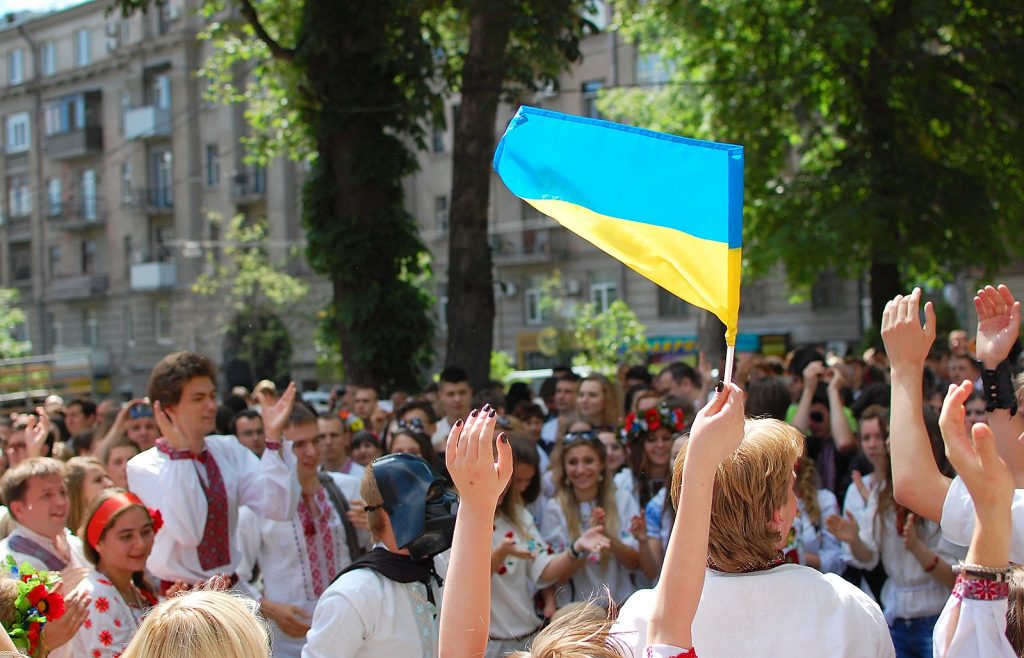 Waving the Ukrainian flag. Credit: Vladimir Yaitskiy. Accessed via Wikimedia Commons. CC BY-SA 2.0
Russia has massed 190,000 troops along its border with Ukraine—enough, according to analysts, to undertake the largest military land operation in Europe since 1945. Ukraine’s generals acknowledge that their military could be overwhelmed by a Russian invasion. But some Ukrainians—including great grandmothers, teenagers, advertising executives, and others—have been quietly preparing to resist. These unlikely civilians practice with prop guns and purchase their own rifles. They have pursued combat-skill classes and hands-on training in private and government-run programs.
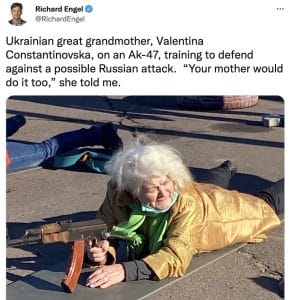
“Your mother would do it, too,” Valentina Constantinovska, a 79-year-old great grandmother, said while holding an AK-47 during a training exercise. Ukrainian citizens engaging in a potential David-and-Goliath-like battle with the colossal Russian military may sound like the plot of a farce. But this army of what one Ukrainian commander estimated at 100,000 resisters could give—and perhaps has already given—Russian President Vladimir Putin pause.
The Ukrainian law “On the Fundamentals of National Resistance,” which took effect on January 1 of this year, enshrines civilian resistance, known as Territorial Defense Forces, into the country’s military doctrine. Should Russia invade, Ukrainians are encouraged to fight back as part of this volunteer force. Admittedly, if Russia were to launch an air or missile strike, an insurgent army of armed Ukrainian civilians would not be poised to help. But a strong citizen resistance offers some hope of deterring a land invasion, especially if supported by Western countries, as many are prepared to do.
“[I]f it turned into a Ukrainian insurgency,” James Stavridis, a retired four-star Navy admiral who was the supreme allied commander at NATO said, “Putin should realize that after fighting insurgencies ourselves for two decades, we know how to arm, train and energize them.”

US Army veterans have also helped train Ukrainian civilians in resistance warfare. “This is their 1776,” US Army Ranger Adam, who withheld his last name due to security concerns, said.
How bad would a nuclear-armed South Korea be? Let us count the ways.
Insurgent armies are not without controversy. The reporter with whom Constantinovska—the great grandmother—spoke tweeted a photo of her that garnered nearly 30,000 likes along with many negative responses. The criticism noted that the training exercise was offered by the far-right movement Azov, which has been accused of harboring neo-Nazi and white supremacist ideology. Residents engaged in the exercise noted that while not all embrace those views, this training in first aid, survival, evacuation, weapons safety, and shooting was all they have received since the start of the citizen-resistance movement in 2014.
“The more coffins we send back, the more the Russian people will start thinking twice,” Ihor Gribenoshko, an advertising executive at a pharmaceutical company, told the New York Times. In addition to potential economic and political sanctions imposed by Western countries, Putin’s calculus of whether to invade must factor in the potential cost in terms of human lives
Ukrainians are relative newcomers to organized citizen resistance. In 2014, the Russian army invaded Ukraine and seized Crimea without firing a shot. Then, in Ukraine’s Donbas region, civilians mounted a resistance, though they had little or no combat training. Today, Ukraine’s military is stronger, though still unlikely to be able to repel a Russian invasion. But a potential battle with citizens who are prepared to fight back could be messier than Russia would like.
“The Russians want to destroy Ukraine’s combat forces. They don’t want to be in a position where they have to occupy the ground, where they have to deal with civilians, where they have to deal with an insurgency,” James Sherr, a Russian military strategy analyst, told the AP.
War has been an environmental disaster for Ukraine
“It’s not even about flats or houses,” Kateryna Pavlova, Chernobyl’s Head of the Department for International Cooperation and Public Relations, said. “It’s about something stronger. It’s in behavior. It’s our language. It’s our country. It’s our flag. It’s our culture.”
Last year, Putin published a long essay in which he trumpeted the “historical unity” of Russian and Ukrainian languages and cultures over more than a millennium. But many Ukrainians do not share his view.
“We hope for a diplomatic solution, but everything will be destroyed if Russia comes,” Pavlova said. “Russia must understand that it will fight not just against our troops and our military. Russian soldiers will meet a very strong population who will fight back.”
As the coronavirus crisis shows, we need science now more than ever.
The Bulletin elevates expert voices above the noise. But as an independent, nonprofit media organization, our operations depend on the support of readers like you. Help us continue to deliver quality journalism that holds leaders accountable. Your support of our work at any level is important. In return, we promise our coverage will be understandable, influential, vigilant, solution-oriented, and fair-minded. Together we can make a difference.
 Who Watches the Watchers?