
 Posted by
 Russia-Ukraine war by the numbers: Live Tracker
As the Russian offensive enters its twelfth day, we track where battles are taking place and the human cost of war, as more than one million refugees stream out of Ukraine.

Who controls what in Ukraine?
Deaths and widespread damage has been reported from several Ukrainian cities as the two sides prepare for third round of peace talks expected on Monday. The US government is considering a ban on oil from Russia in a push to ramp up pressure on Moscow over its invasion of Ukraine. Ukrainian President Volodymyr Zelenskyy has urged the West to strengthen sanctions on Russia.

Where are people fleeing to?
More than 1.7 million people have fled Ukraine since Russia launched its invasion, according to the UN Refugee Agency’s data portal. Many have sought refuge in Poland and other neighbouring states.
The latest and still growing count had 1,027,603 people entering Poland, 180,163 in Hungary, 128,169 in Slovakia, 82,762 in Moldova, 78,977 in Romania, 53,300 in Russia, and 406 in Belarus. At least 183,688 people have also fled to other European countries.
Most of the arrivals have been women and children. All men aged between 18 and 60 have been prevented from leaving Ukraine to stay and fight.

Anti-war protests around the world
Thousands of people have taken to public squares and Russian embassies across the globe to protest against the invasion.
OVD-Info, which has documented crackdowns on Russia’s opposition for years, says more than 5,000 demonstrators have been arrested across Russia since President Vladimir Putin launched the war on Ukraine.
The map and list below show the locations where sizeable protests have occurred. More protests are planned in the coming days across cities worldwide.
https://flo.uri.sh/visualisation/8807042/embed
World cities where protests have taken place:
Adana; Amsterdam; Antwerp; Athens; Atlanta; Austin; Baku; Bangkok; Barcelona; Bari; Beirut; Berdyansk; Berlin; Bern; Bloomington; Bordeaux; Boston; Brighton; Brussels; Budapest; Buenos Aires; Caernarfon; Cambridge; Cape Town; Chicago; Colombo; Copenhagen; Curitiba; Denver; Dublin; Edinburgh; Exeter; Frankfurt; Geneva; Glasgow; Guayaquil; Helsinki; Houston; Istanbul; Krakow; Kuala Lumpur; Lahore; London; Lisbon; Madrid; Malmo; Manchester; Manila; Marseille; Melbourne; Mexico City; Milan; Milwaukee; Minneapolis; Minsk; Montclair; Montpellier; Montreal; Munich; Naples; Newcastle; New Delhi; New York City; Nice; Norwich; Nottingham; Oslo; Ottawa; Oxford; Paris; Podgorica; Prague; Pretoria; Pristina; Quezon City; Rome; Salerno; San Francisco; Santa Monica; Santiago; Sao Paulo; Seoul; Stockholm; Sydney; Taipei; Tallinn; Tbilisi; Tehran; Tel Aviv; The Hague; Thessaloniki; Tirana; Tokyo; Toronto; Turin; Vancouver; Vienna; Vilnius; Warsaw; Washington, DC; Wellington; Zakopane.
Protests have taken place in at least 50 Russian cities, including Chelyabinsk, Moscow, Nizhny Novgorod, Novosibirsk, Perm, Saint Petersburg, Samara, and Yekaterinburg.
Ukraine and Russia explained in 8 maps and charts
Below are eight infographics that break down the history, politics and economics of the Ukraine-Russia crisis.
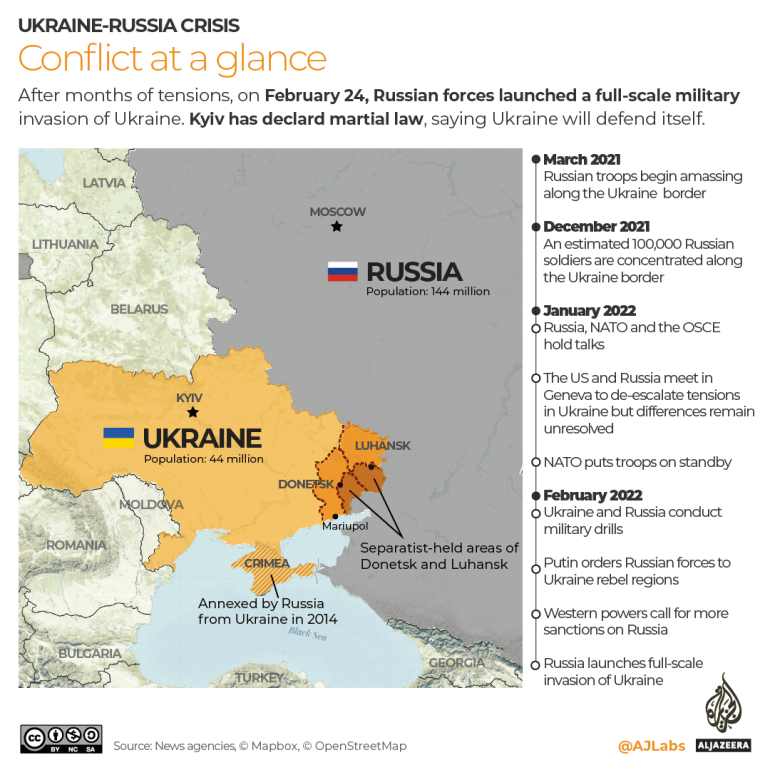
1. Conflict at a glance
After months of tensions and intense diplomacy, Russian forces invaded Ukraine. Explosions were heard across the country. Kyiv declared martial law, saying Ukraine will defend itself. Below is a summary of the conflict at a glance.
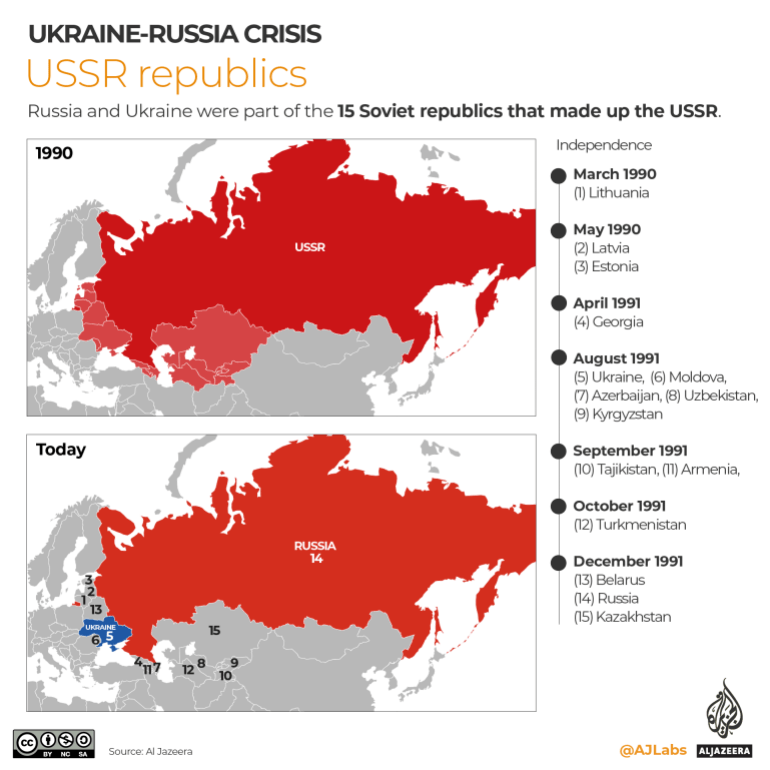
2. History of the USSR
Russia and Ukraine were part of the 15 Soviet republics that made up the Soviet Union. Following the collapse of the Soviet Union in 1991, Ukraine declared independence on August 24. The map below shows when each of these countries declared independence.
3. Political leadership
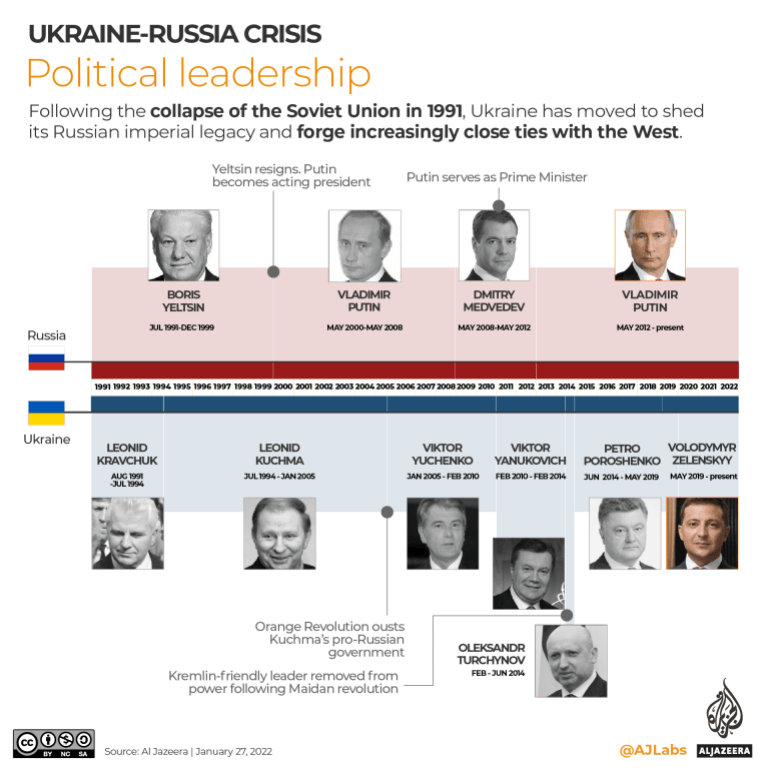
After independence, Ukraine moved to shed its Russian imperial legacy and forge increasingly close ties with the West.
Over the past 30 years, Ukraine has been led by seven presidents. The country has had a rocky path towards democracy with two revolutions, first in 2005 and then in 2014. Both times, protesters rejected Russia’s supremacy and sought a path to join the European Union and NATO.
By comparison, Russia has been led by three presidents, with Putin having been in office for 17 years. In 2021, Putin, the former agent of the Soviet Union’s KGB security services, signed a law which essentially enables him to stay in power until 2036.
Putin has repeatedly claimed that Russians and Ukrainians belong to “one people” and are part of the historical “Russian civilisation” that also includes neighbouring Belarus. Ukrainians reject his claims.
4. How big are Ukraine and Russia?
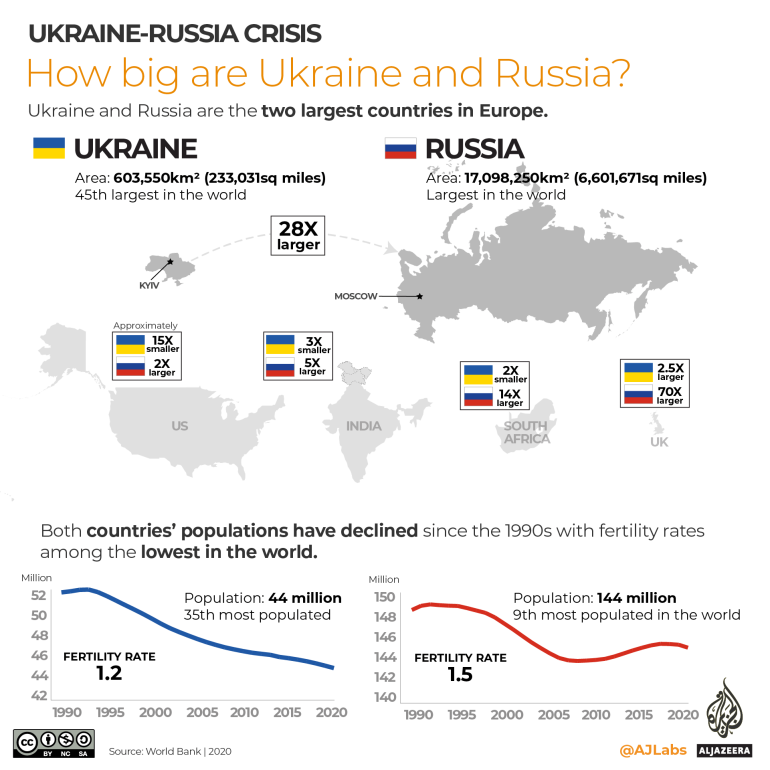
Ukraine has an estimated population of 44 million – the seventh-largest in Europe. The country comprises 24 regions, known as oblasts. The country’s population has declined since the 1990s with fertility rates among the lowest in the world. As of 2020, Ukraine’s fertility rate was just 1.2. For context, in order for a population to remain stable, an overall total fertility rate of 2.1 is required.
Ukraine is the second-largest country in Europe, after Russia. At 603,550sq km (233,031sq miles), Ukraine is a bit smaller than the US state of Texas, about three times smaller than India, half the size of South Africa and about two and a half times the size of the UK.
5. NATO in Europe
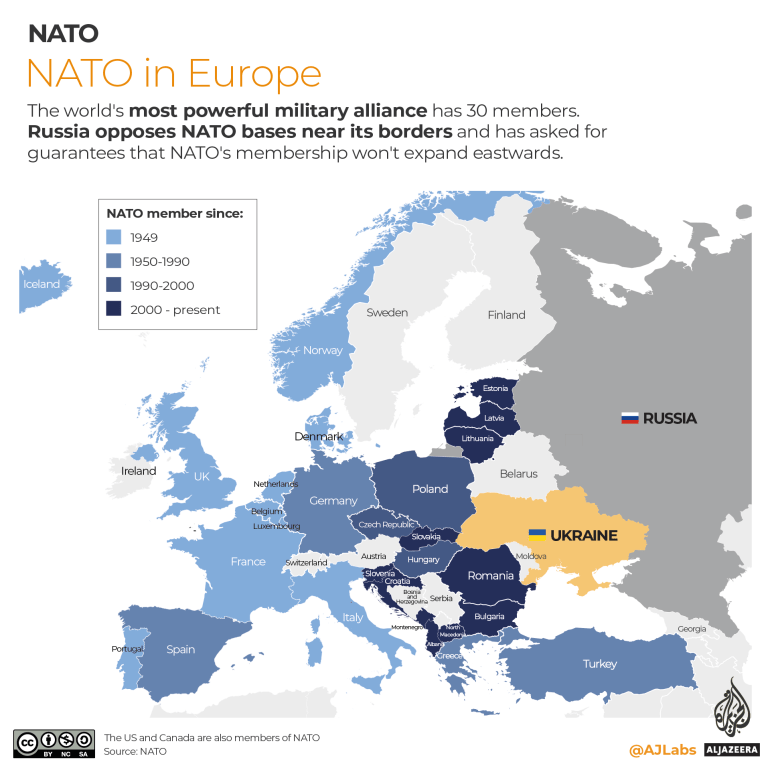
NATO is the world’s most powerful military alliance. Comprising 30 nations, its primary role is to protect its member states by political and military means.
Russia opposes NATO bases near its borders and has asked for written guarantees that NATO will not expand eastwards. One of the Kremlin’s central demands is that Ukraine never be allowed to join NATO – a move it considers a red line. The United States has refused to concede to this demand.
Read more about NATO history and expansion here.
6. Military head-to-head
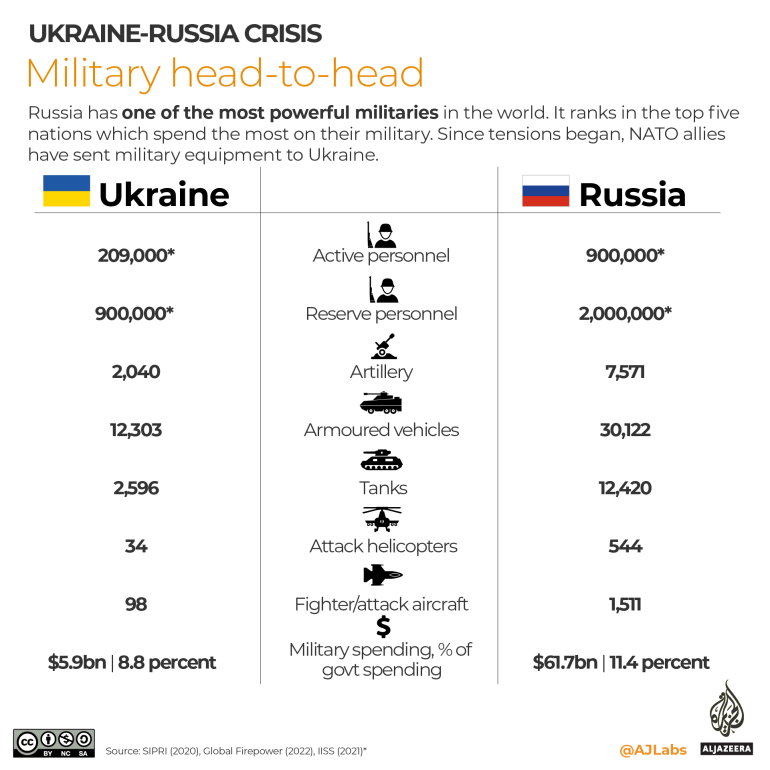
Russia has one of the most powerful militaries in the world and ranks among the top five defence spenders.
In 2020, Russia spent $61.7bn on its military, which accounted for 11.4 percent of government spending. In comparison, Ukraine spent $5.9bn on its armed forces, or 8.8 percent of government spending, according to the Stockholm International Peace Research Institute.
Since tensions began, NATO allies, fearful of a potential ground invasion by Russia, have stepped up support for Kyiv by sending military equipment to Ukraine.
Read more about the military capabilities of Russia and Ukraine here.
7. Oil and gas resources
Russia and Ukraine are both rich in oil and gas. Russia has the world’s highest proven gas reserves at 48,938 billion cubic metres. More than 70 percent of the country’s gas reserves are held by Gazprom, a state-owned energy giant.
Russia supplies about one-third of Europe’s natural gas. US sanctions over the conflict could disrupt that supply, exacerbating Europe’s energy crisis. On February 22, Germany halted the certification of Nord Stream 2, an $11.6bn Russian gas pipeline project that was designed to move 151 million cubic metres of gas a day into Europe.
Russia also has some of the largest proven oil reserves, at 80 billion barrels, or 5 percent of the world’s total.
Ukraine, too, has a sizable reserve of oil and gas at 395 million barrels and 349 billion cubic metres, respectively. The country sits at the crossroads between the West and Russia, and plays a key role in delivering Russian gas to European markets.
Read more about the world’s oil and gas pipelines here.

8. Russia and Ukraine’s main exports
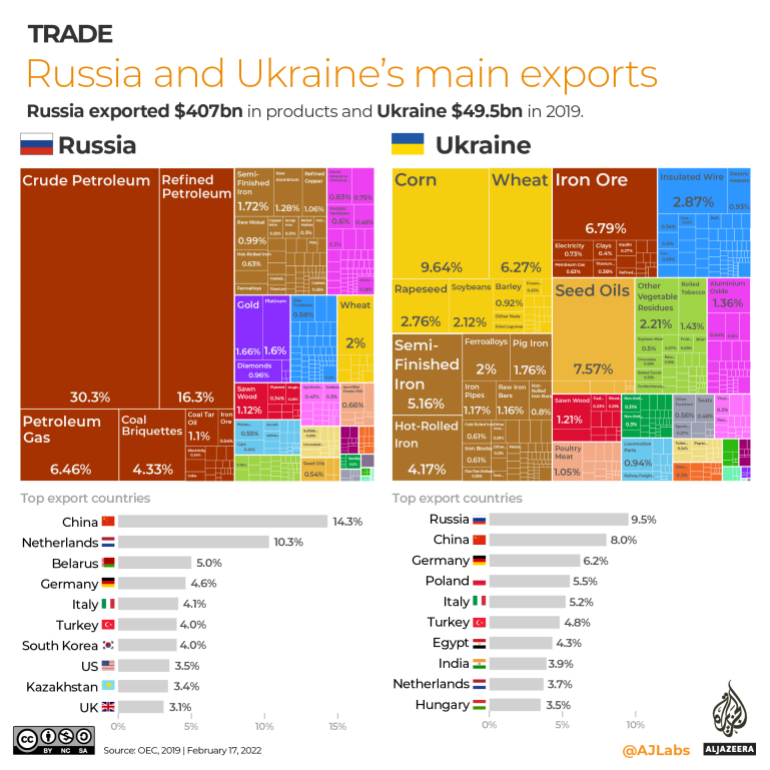
More than one-quarter of the world’s wheat exports come from Russia and Ukraine. Economic sanctions or military action may have a significant effect on the cost of food as importers seek to find alternatives. Russia exported $407bn in products and Ukraine $49bn in 2019.
Read more about Russia, Ukraine and the global wheat supply here.
Source: Al Jazeera
More from News
- Soaring food prices threaten emerging-market currencies
![The pace of food price inflation is rendering emerging-market countries' currencies vulnerable [File: Akos Stiller/Bloomberg]](https://www.aljazeera.com/wp-content/uploads/2022/03/food4.jpg?resize=170%2C113)
- Orban allows deployment of NATO troops in western Hungary
![Orban attends a NATO leaders virtual summit at NATO headquarters in Brussels [File: Olivier Matthys/AP]](https://www.aljazeera.com/wp-content/uploads/2022/03/AP22059761951969.jpg?resize=170%2C113)
- Russia snubs UN court hearing in case brought by Ukraine
![Ukrainian envoy Anton Korynevych urged Russia to 'lay down your arms and put forward your evidence' [File: Eva Plevier/Reuters]](https://www.aljazeera.com/wp-content/uploads/2022/03/2022-02-09T050023Z_2071303555_RC25GS9OYI40_RTRMADP_3_CONGO-UGANDA-WORLD-COURT.jpg?resize=170%2C113)
- Ukraine’s Roma refugees recount discrimination en route to safety
![Cristina (L) and Larisa (R), Roma refugees, speak to Al Jazeera at the Manej Sport Arena that serves as a refugee centre in Chisinau, Moldova [Andrei Popoviciu/Al Jazeera]](https://www.aljazeera.com/wp-content/uploads/2022/03/Cristina-L-and-Larisa-R-2.jpg?resize=170%2C113)
![The latest round of negotiations is expected to focus on humanitarian corridors [Foreign Ministry of Belarus via Anadolu]](https://www.aljazeera.com/wp-content/uploads/2022/03/20220307_2_52493190_74392183.jpg?resize=170%2C113)
![If China steps in and pressures Putin to end this war now, with a now dependent Russia as its sidekick, it could dominate Eurasia with its Belt-Road Initiatives, writes Chin-Huat Wong [Reuters]](https://www.aljazeera.com/wp-content/uploads/2018/03/bc629a7c297d4adfaf03666de0e79b55_18.jpeg?resize=170%2C113)
![Refugees fleeing the war in Ukraine form a line as they approach the border with Poland in Shehyni [File: AP Photo]](https://www.aljazeera.com/wp-content/uploads/2022/03/AP22065825867765.jpg?resize=170%2C113)
 Who Watches the Watchers?