
 Posted by
 The war in Ukraine highlights the failures of the EU’s Eastern Partnership
The fallout of Russia’s attack on Ukraine will be massive in the Western Balkans, and Europe and her allies need to prepare for it
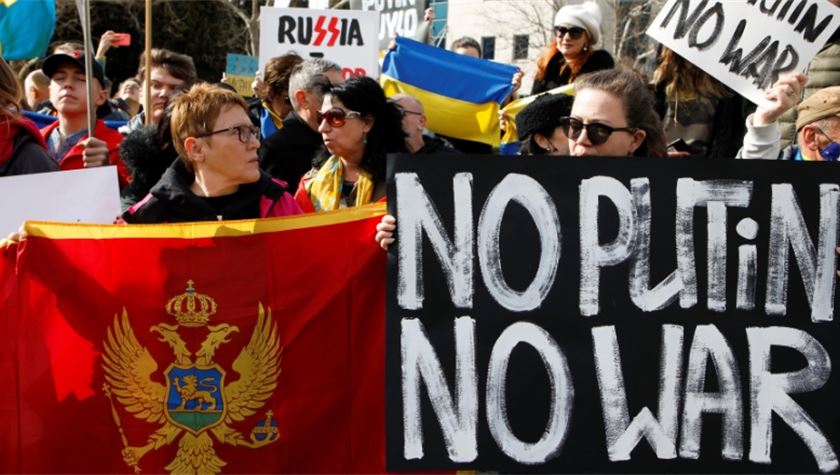
Demonstrators attend an anti-war protest march, after Russia launched a massive military operation against Ukraine, in Podgorica, Montenegro February 27, 2022. | Photo credit: REUTERS/Stevo Vasiljevi

By Toby Vogel
Toby Vogel is a co-founder and senior associate of the Democratization Policy Council based in Brussels.
03 Mar 2022
President Putin’s brutal attack on Ukraine has upended many certainties in Europe. Germany is sending deadly armour to the Ukrainians, topping up its defence budget, and stopping Nord Stream 2 – each one of these steps near-unthinkable until before this weekend.
Non-NATO members Finland and Sweden, too, are sending weapons, and pro-NATO sentiment in both countries is gaining momentum. Switzerland, a haven for Russian capital and commodities trading, is clamping down on both.
But perhaps the most unexpected effect of the Kremlin’s naked imperialism is the way it has united the Member States of the European Union. This weekend, they adopted the EU’s toughest sanctions regime ever and agreed on direct arms supplies to the Ukrainians. Even Hungary’s government, the most pro-Kremlin in the EU, supported these moves.
The EU took Russian disinformation outlets Sputnik and RT off the air, froze the assets of dozens of oligarchs, and restricted the Kremlin’s ability to trade with the rest of the world. Officials are working around the clock to draft plans to make Europe less dependent on Russian gas. EU foreign policy chief Josep Borrell, addressing the European Parliament on Tuesday, welcomed the “birth of Europe as a geopolitical actor”.
The mood in Bosnia and Herzegovina, where I lived for six years after the war, is especially tense.”
One region where demand for a more geopolitical EU is growing is the Western Balkans: the six countries of the peninsula that are outside the EU. They feel vulnerable to Russian influence, notably through Russian-aligned Serbia and the Kremlin’s allies among the Bosnian and Montenegrin Serbs. EU members Croatia and Slovenia have also been as open to Russian influence as Hungary.
The mood in Bosnia and Herzegovina, where I lived for six years after the war, is especially tense. Many of my friends, who spent three and a half years under Serbian shelling, feel triggered by the images reaching us from Kharkiv and other cities. Bosnian Serb leader Milorad Dodik, with the backing of Serbian President Aleksandar Vučić, manufactured a political crisis last summer that gave him a pretext to push for secession; many saw the Kremlin’s hand behind his moves.
In the last few days, there have been indications that Russia is putting pressure on Dodik to declare independence (a step from which he has so far shied away) and on Vučić to recognise it. Even if the rumours turn out to be false, they have further shaken an already shaky population. And so far, the EU’s response has been tepid: instead of confronting Dodik and showing his demands to be unacceptable, Enlargement Commissioner Olivér Várhelyi – Prime Minister Orbán’s man in Brussels – signalled that they were all negotiable, including the repeal of a genocide denial law. Its imposition by the top international envoy in Sarajevo was the pretext for Dodik’s secessionist moves last summer.
So far, the EU’s response has been tepid: instead of confronting Dodik and showing his demands to be unacceptable, Enlargement Commissioner Várhelyi signalled that they were all negotiable.”
Could the EU’s unexpectedly robust and united response to Russia’s attack herald a change in its weak position against Moscow’s clients in the Balkans?
Of course, as was to be expected, the lofty words of EU leaders soon collided with reality. A claim by Borrell on Sunday that the EU would provide fighter jets turned out to be wrong barely a day later, when the three countries supposedly involved denied having any such plans. This was highly embarrassing and distracted from the historic unity achieved by the European Council on Sunday.
Try 5 copies of The Parliament Magazine for just €5.00 / £5.00Subscribe
Follow us
Registered office: 11th Floor, The Shard, 32 London Bridge Street, London SE1 9SG
Company number: 04267888
© Merit Group plc 2022
Quick Links
Services
Media & Publishing
- PoliticsHome
- Holyrood
- Civil Service World
- The House Magazine
- PublicTechnology
- Training Journal
- Subscribe to Dods media titles
About Dods
 Who Watches the Watchers?