
 Posted by
 UAE aims to go green while continuing to produce oil
Kingdom’s climate envoy tells UN confab that fossil fuel phaseout ‘cannot be rushed,’ that oil will still be needed in future, and that UAE can produce it with low carbon emissions
By Sue Surkes Today, 5:06 am

This screenshot from undated footage released by Strategy & Government Communications of Dubai, shows the Mohammed bin Rashid Al Maktoum Solar Park, about 50 kilometres south of Dubai, United Arab Emirates. (Strategy & Government Communications of Dubai via AP)
DUBAI, United Arab Emirates — The United Arab Emirates’ commitment to environmental sustainability, on the one hand, and to continuing oil production, on the other, came to the fore on Monday at an address by the country’s climate change envoy.
Speaking at the opening event for the first-ever UN Middle East and North Africa Climate Week, Dr. Sultan Al Jaber said that the UAE was the first country to sign the Paris Climate Agreement in 2015, the first to announce the goal of net-zero carbon emissions by 2050, and host to the world’s biggest single solar field.
The country stopped flaring (burning natural gas from oil extraction) 30 years ago, he added, radically slashed methane emissions 20 years ago, and began capturing climate-warming carbon dioxide long before people started talking about it.
At the same time, “we can’t just switch off the energy system, as current events show,” he said, referring to the rising price of oil brought on by the Russian invasion of Ukraine alongside restricted supply in the face of a rapid uptick in consumer demand in the COVID era.
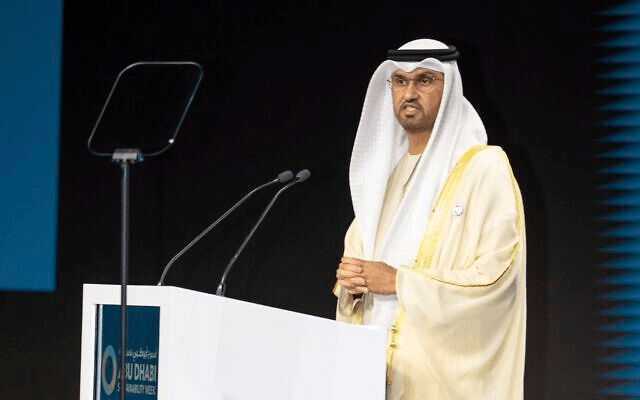
Dr. Sultan Ahmed Al Jaber, UAE Minister of Industry and Advanced Technology and UAE Special Envoy for Climate Change, pictured at the opening of Abu Dhabi Sustainability Week on January 17, 2022, in Abu Dhabi, UAE. (Mohamed Nazih/AP Images for Abu Dhabi Sustainability Week)
Weaning the world off hydrocarbons “will be gradual, and needs sober planning,” Al Jaber said. “It cannot be rushed.” The push to reduce hydrocarbons was having an impact on those who were most vulnerable, he added, noting that it is important to keep investing in low-cost, low carbon energy.
Get The Times of Israel’s Daily Editionby email and never miss our top stories
 Who Watches the Watchers?
