 Posted by
 Turning to Israel, Germany to get weaponized drones for the first time
After years of debate, defense committee approves purchase of 140 Heron TP armed drones from Israel, in contract worth $165 million
By AFP and TOI staff 6 April 2022, 7:56 pm
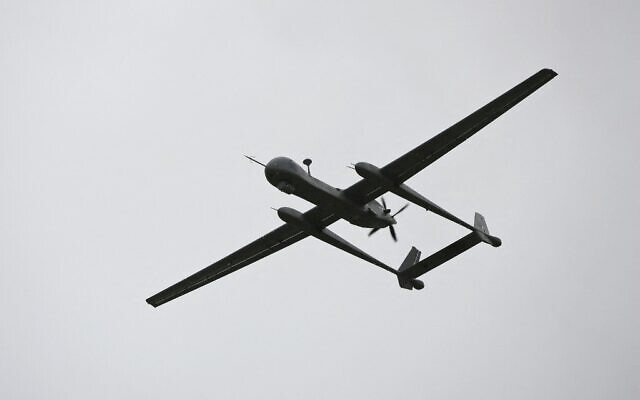
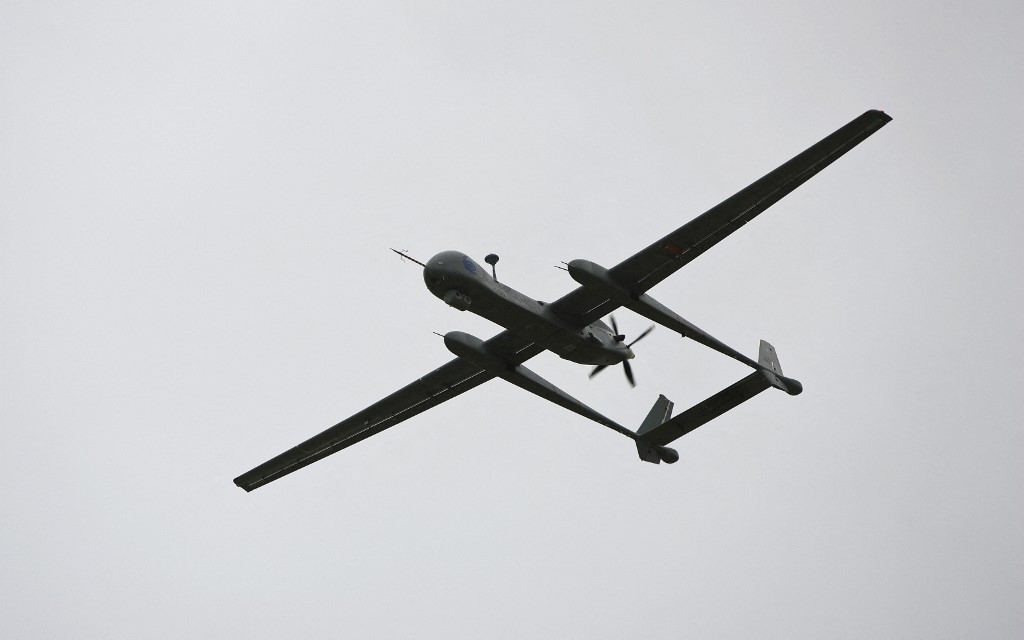
This file photo taken on February 21, 2010 shows an Israeli Heron TP surveillance drone, known as the IAI Eitan, during a presentation to the media at the Tel Nof Air Force base, south of Tel Aviv. (Jonathan Nackstrand/AFP)
Germany will get weaponized drones for the first time after years of debate, parliamentary sources told AFP Wednesday, as the EU giant, shaken by Russia’s invasion of Ukraine, moves to ramp up its defense capabilities, turning to Israel for its military needs.
On Wednesday, the parliamentary defense committee approved the purchase of 140 Heron TP armed drones from Israel in a contract worth $165 million, sources said.
The drones are expected to be delivered within two years, with 60 of them to be used for training purposes while the remaining 80 will be used for “operational deployment.”
Germany is also mulling acquiring an anti-missile shield system from Israel. The Arrow 3 system, costing around two billion euros ($2.2 billion), is powerful enough to offer protective cover for neighboring EU nations.
“The security situation in Europe has essentially changed with the attack of Russia on Ukraine,” the defense ministry said in a position paper put to the parliamentary committee and seen by AFP.
Get The Times of Israel’s Daily Editionby email and never miss our top stories Newsletter email address
By signing up, you agree to the terms
“In order to counter the new threat, the Bundeswehr’s equipment must be upgraded without delay, including in particular the arming of the Heron drones. The need is absolutely necessary because serious state interests of a political nature would be otherwise compromised and this is not acceptable.”
Germany’s armed forces have until now only been allowed to deploy unarmed drones for reconnaissance purposes, leaving other allies to use weaponized unmanned combat aerial vehicles in the field.

German soldiers stand in line during a visit of Governor Hendrick Wuest at the army base Field Marshal Rommel Barracks in Augustdorf, Germany, on Wednesday, March 30, 2022. (AP Photo/Martin Meissner)
Non-weaponized drones were approved by parliament in 2018, but a plan to equip them with arms was put on ice after strong opposition from the Social Democrats, then junior partners in former chancellor Angela Merkel’s coalition.
But the devices have come back on the military’s shopping list as Chancellor Olaf Scholz, himself a Social Democrat, announced a massive spending spree to equip Germany militarily after Russian President Vladimir Putin’s offensive in Ukraine.
Disrepair
Germany’s army has been suffering from underinvestment over the years.
Defense commissioner Eva Hoegl’s latest report of the state of the military had underlined a litany of equipment issues — from the majority of combat vehicles, naval ships, and fighter jets in disrepair to a woeful lack of newer generation arms like rifles or even parachutes.
Scholz had announced in a landmark speech three days after Russian troops marched into Ukraine that Germany would set aside a special budget of 100 billion euros ($109 billion) for the military, as well as use more than two percent of its output on defense annually.
Since then frantic negotiations have been ongoing to close huge defense deals, including a purchase of up to 35 F-35 fighter jets from the United States and 15 Eurofighter jets from a consortium that includes Airbus.
We’re telling a critical story

Israel is now a far more prominent player on the world stage than its size suggests. As The Times of Israel’s Diplomatic Correspondent, I’m well aware that Israel’s security, strategy and national interests are always scrutinized and have serious implications.
It takes balance, determination, and knowledge to accurately convey Israel’s story, and I come to work every day aiming to do so fully.
Financial support from readers like you allows me to travel to witness both war (I just returned from reporting in Ukraine) and the signing of historic agreements. And it enables The Times of Israel to remain the place readers across the globe turn to for accurate news about Israel’s relationship with the world.
If it’s important to you that independent, fact-based coverage of Israel’s role in the world exists and thrives, I urge you to support our work. Will you join The Times of Israel Community today?
Thank you,
Lazar Berman, Diplomatic Correspondent
Yes, I’ll give Already a member? Sign in to stop seeing this
 Who Watches the Watchers?