
 Posted by
 07-16-2024IMPACT
Amazon Prime Day is a ‘festival of consumption’—and it’s terrible for the environment
Even with the steps Amazon is taking toward sustainability, the scale of Prime Day has a huge environmental impact. 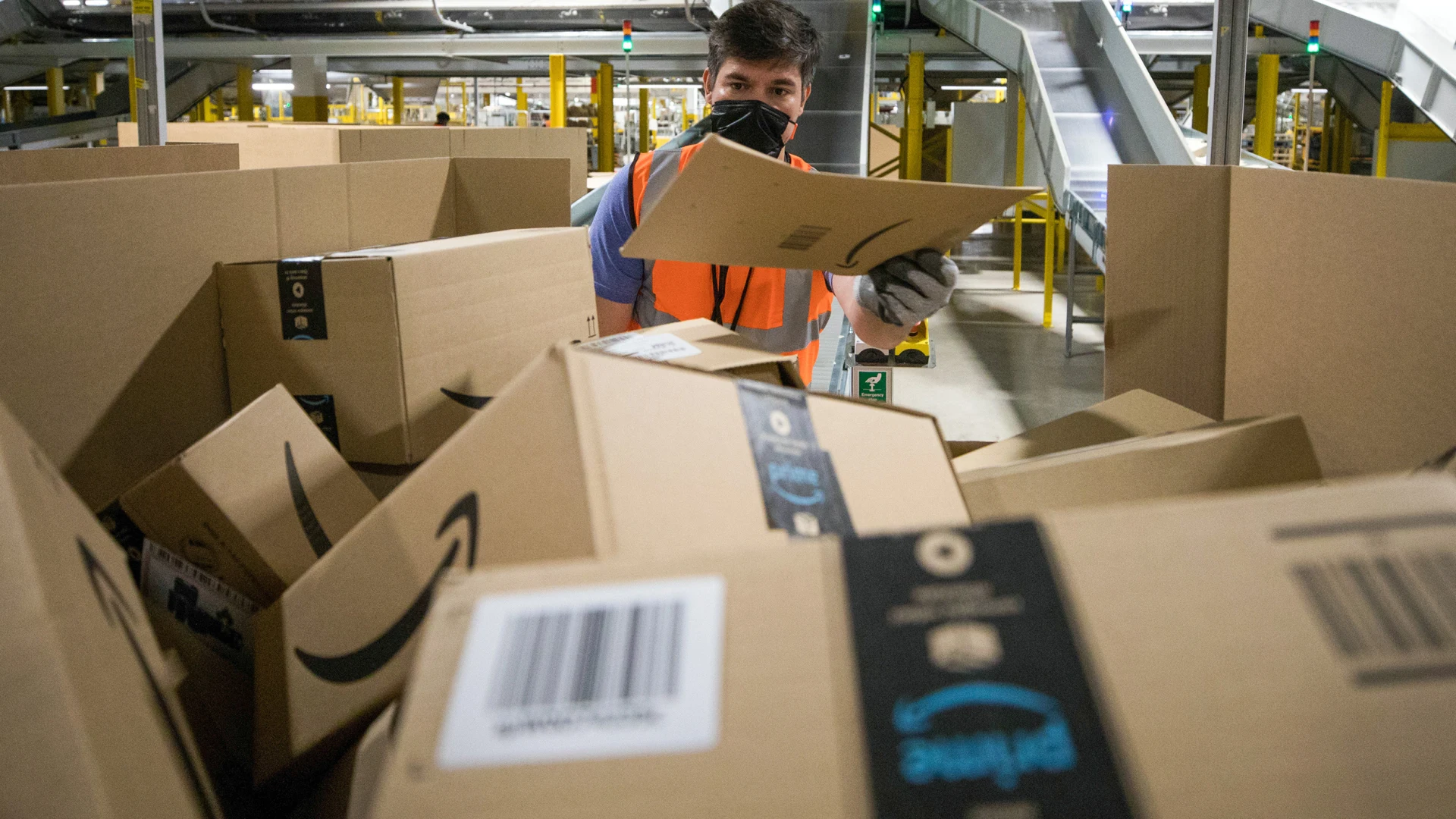
[Photo: Chris Ratcliffe/Bloomberg/Getty Images
BY Kristin Toussaint 8 minute read
Amazon has undoubtedly changed the way people shop. And each year, Amazon Prime Day—its now-landmark summer sales event—gets bigger and bigger. In 2023, the first day of Prime Day (which spans two days) was the single largest sales day in the company’s history. Across both days last year, customers purchased a total of 375 million items.
Amazon Prime Day 2024 is set to break records once again. Headline upon headline advertises the best Prime Deals in attempts to lure customers, and there are even “early deals” ahead of the official event. But what’s the environmental cost of all this consumption?
Amazon has taken steps to consider its environmental impact. The company has swapped in 100% recycled paper where it previously used plastic air pillows in its packaging. It has rolled out more than 24,000 electric delivery vehicles to reduce emissions from shipping. It has a goal to reach net zero emissions by 2040.
But despite all that, the scale of Prime Day is one that is inherently incompatible with the planet’s health. Experts warn about the immense plastic waste from Amazon, even as it scales back its plastic use; the emissions from not only the company’s operations but the production of all the stuff it sells; and the dangers of overconsumption itself.
“We’ve been making more and more efforts to green our consumption,” says J.B. MacKinnon, an environmental journalist and author of the book The Day the World Stops Shopping. “And all those efforts are just being overwhelmed by the fact that we consume more and more and more every year.”
The Scourge of Plastic Packaging
When Amazon stopped using plastic air pillows in its packaging, it had a tremendous impact. Last year, the company used nearly 15 billion such cushions in North America alone, and these largely can’t be recycled in curbside bins. Amazon says it’s already replaced 95% of those plastic air pillows, and that by the end of the year, they’ll be removed from every package. That means, an Amazon spokesperson noted, that nearly all of its Prime Day deliveries won’t contain plastic air pillows.
To Celeste Meiffren-Swango, who runs the Beyond Plastic program at Environment America, a network of 30 state environmental groups, this is a big step in the right direction. Because of Amazon’s scale as the largest online retailer in the world, “every action that Amazon takes to reduce plastic has a big impact on our plastic pollution problem,” she says. But there’s also more work to do.
Environment America continues to push for Amazon to reduce all its single use plastic. Last summer, the company announced it would phase out its single-use plastic shipping bags “in favor of recyclable alternatives.” “But there was no timeline for when that was going to happen,” Meiffren-Swango says. Environment America is pushing for a hard, and ambitious, deadline for that goal.
Most plastic packaging, from both Amazon and other retailers, isn’t recyclable, she adds. Ultimately, it ends up in landfills, incinerators, or littering waterways. A March 2024 report that Environment America did with the nonprofit Public Interest Research Group (PIRG) looked specifically at where Amazon’s plastic packaging ends up. The groups put trackers into 94 bundles of plastic film packaging—plastic bags, bubble-lined bags, and air pillows—that were dropped off at designated locations for recycling.
Only four actually went to centers that sort items for recycling; 13 ended up in landfills, two to an incinerator, and three to the Port of Los Angeles. More than 20 went to a company that makes plastic benches and decks out of plastic film and reclaimed sawdust. In that case, the plastic was being downcycled. While technically better than a landfill, those downcycled products generally can’t be recycled themselves. Turning plastic packaging into another product doesn’t decrease the need for virgin plastic to produce new packaging.
“The results of that report really demonstrate the need for [Amazon] and other companies like it to stop labeling plastic film packaging as recyclable, move away from recycling as the solution when it comes to plastic, and focus more on reducing the amount of plastic that it uses in the first place,” she says.
Other environmental impacts of Amazon Prime Day
Plastic packaging is just one part of the company’s environmental impact. There’s also emissions. Last year, carbon accounting firm Greenly estimated that in 2022, Prime Day accounted for more than 1.2 million tonnes of carbon dioxide emissions—equivalent to the annual emissions of 68,000 Americans.
That estimate, though, is just for Amazon sales, and doesn’t include the life cycle of the products themselves. For as much as Amazon can work to make its operations more environmentally friendly with reduced plastic packaging, renewable electricity, and low-emissions shipping, there’s still the environmental impact of everything it sells.
Most of the emissions associated with a product are going to come from manufacturing that product, MacKinnon says. Take digital devices or electronics, a hugely popular category on Amazon Prime Day—kindles, phones, speakers, earbuds, cameras, smart watches, and more. “These things are loaded with plastic and critical minerals,” he says. “They often have really short lifespans before we need to replace or upgrade them, and they use huge amounts of energy when we use them.”
The emissions from the things Amazon sells are known as Scope 3 emissions. Amazon does say it’s looking to support third parties in their own decarbonization efforts. This month, it announced a website with “previously proprietary information” that other companies can use to decarbonize their own supply chains. In 2023, the company says its Scope 3 emissions decreased 5% because of reductions related to buildings and equipment, and because more items were shipped by Amazon rather than third-party transportation. Going forward, it says it will prioritize working with suppliers who are committed to reaching net-zero operations.
Amazon’s own decarbonization efforts have come under recent scrutiny, though. While the company says it hit its goal of 100% clean power, employees say only 22% of the company’s U.S. data centers actually run on renewables. (Amazon maintains its report has the correct data, and that the employee group’s report has incorrect findings and assumptions.)
A festival of overconsumption
At the crux of Amazon Prime Day’s environmental impact is the issue of overconsumption. Making a specific product more eco-friendly or making a supply chain “greener” is just one step—and it’s not enough, MacKinnon says. “If we really want to get serious about reducing the impacts of consumption, then the most obvious and effective way to do that is to actually reduce consumption.”
Maybe there are things you’ve been putting off buying until Amazon Prime Day because of cost constraints and the impacts of inflation. If it’s something you truly need, it’s understandable to take advantage of a sale. But both Meiffren-Swango and MacKinnon argue that most of the things people will buy on Prime Day won’t really benefit them long term.
“All the evidence suggests that this consumption is very, very harmful to the environment, and it’s really not adding that much happiness to most people’s lives,” MacKinnon says. Instead, it’s perpetuating the increasingly rapid cycle of buying, using, and then disposing of consumer goods, which Meiffren-Swango says actually “costs families a lot of money, while also growing our landfills, depleting our natural resources, and warming our climate.”
If you regret your purchase, you can likely return it; most items shipped by the company on Amazon Prime Day can be refunded within 30 days. But then you’re adding to the massive problem of waste from returns. At just one U.K. Amazon fulfillment center, a former employee said the warehouse destroyed 130,000 products (some returned, some new) each week. All retail returns contribute to waste: in 2022, about 9.5 billion pounds of waste from returns was sent to landfills.
Companies pushing consumerism isn’t new. We live in a consumer culture, which is the basis of our economy even though it has negative environmental impacts (this is the tension MacKinnon explores in his book). Amazon Prime Day—which began in 2015—is a prime example of consumerism for the sake of consumerism, a Christmas in July, a “new giant consumer frenzy that we’ve put on the calendar,” MacKinnon says. “But unlike Christmas, it’s not about anything other than buying more stuff . . . It really is just a festival of consumption.”
And it’s spurred competitors to follow suit: Target Circle week, Temu week, and Walmart Deals add to the summer shopping season. Before this trend, summer was usually a slow time for spending. “What’s different now that makes it so we feel we have to have this consumer splurge right in the middle of the best time of year for just enjoying the simple pleasures of life?” MacKinnon says.
MacKinnon acknowledges that people can get a little boost of happiness when buying new things, “and if you can line up enough of those boosts, then it starts to feel like you’re happy all the time.” But these are like empty calories. Eventually, he says, people get exhausted from this cycle, “and it’s not a deep and lasting satisfaction.”
If buying a particular product does make you happy—beyond the quick dopamine hit of receiving a package—that’s when you’re likely consuming “on your own terms,” he adds, and not being swayed by advertising or the allure of a deal. Research has backed this up, finding that purchases in line with your personality tend to increase happiness; it has also linked spending on experiences with more satisfaction, which can extend to products that help create experiences, like a bicycle or book. Some people will always shop, but it’s about doing so more intentionally,
To get to that level, he suggests taking a day to think about if you really need to buy something. (More and more people are also opting out of traditional consumerism completely, getting a boost of joy from something they find in a Buy Nothing Group or shopping second hand, which lessens the environmental impact of things we still want to own.)
The manufactured urgency of sales can make taking that pause difficult, of course. Still, MacKinnon urges intentionality. “As individuals, we should still feel that we have the choice to buy as much or as little as we want to. We don’t live in a consumer dictatorship,” he says. “I think people really should just take some time to take back control of their consumption from the algorithms and advertising and these very powerful forces that are targeting us and encouraging us to consume.”
Recognize your technological breakthrough by applying to this year’s Next Big Things in Tech Awards! Extended Deadline to Apply Tonight, Friday, July 19.
 Who Watches the Watchers?