
 Posted by
 The catastrophe of the floating continent: Tourism
The massive global tourism industry doesn’t have factories that emit smoke. And yet, this sector can damage space, tranquility and entire communities
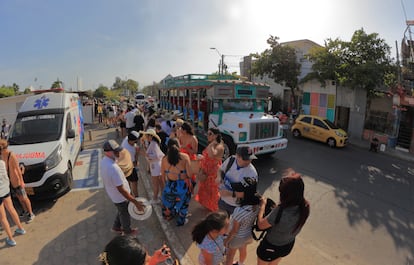
Fernando Rojas Parra
When I was a child, traveling was a great adventure. By car, bus, or plane, each destination represented a discovery, the possibility of meeting up with family, or an exciting vacation. I also remember that, for many people, contact with international cultures was only possible through books or through TV programs.
Over time, everything changed. I’m not exactly sure when, but there’s no doubt that the increase in income across various social sectors, the accessibility of means of transportation and the consolidation of a traveling spirit boosted global tourism to unimaginable levels.
To give you an idea, in the first three months of 2024 alone — according to the U.N. Tourism Barometer — nearly 285 million tourists traveled internationally, or 20% more than in the same period in 2023. And — along with finance, trade and energy — tourism is one of the main sectors of the world economy. This is confirmed by the huge amounts of money it moves.
In 2023, total international tourism revenues exceeded $1.7 trillion — 96% of pre-pandemic levels — while the direct GDP of the sector reached $3.3 trillion, equivalent to 3% of global GDP. On top of that, the U.N. Tourism Barometer estimates that tourism will exceed pre-pandemic levels in 2024, while its growth will be 16%, with an upward trend for the next five years.
For this reason, countries and cities of all sizes are trying to become attractive to a diverse national and international demand, aware of its powerful impact on the economy and employment. At the same time, experts and authorities are calling for sustainable tourism, which cares about the environment, limits consumption and reduces waste. Concerns about tourism have increased over the years, as governments and affected residents of tourist destinations grapple with how to manage — and even limit — the pressures caused by visitors. It is posing a challenge for coexistence.
Ahmed Al Khateeb — president of the Executive Council of U.N. Tourism and Saudi Arabia’s minister of Tourism — said in an EL PAÍS interview that “mass tourism is creating a feeling of anguish, very close to panic. It’s this sixth floating continent, malleable, that expands exponentially in all areas of the planet and destroys everything it passes through.” It invades everything!
As Spanish journalist Jorgi Dioni López notes, “the tourism industry doesn’t have factories that emit smoke. It’s invisible, but it occupies everything.” That’s why it’s so difficult to notice its voracious pace. What’s initially seen as progress actually deteriorates the space and the community. In the words of anthropologist José Masilla, tourism sells what it doesn’t own. No wonder things have gotten out of control.
Recently, voices that are rejecting mass tourism have been heard loudly in Barcelona, Madrid, the Canary Islands, Paris, Tokyo, Cancun, Venice, the Greek islands, Rio de Janeiro, the Amazon, Cartagena and many other popular spots. The problems raised are the same, regardless of the clamoring population: rising prices, excessive noise, crowding, disruption of daily life, breakdown of the social fabric and the expulsion of city dwellers, all because of rising numbers of tourists.
What to do? Well, we can look at Japan, where there’s a tourism boom. The weakness of its currency and the relaxation of post-pandemic restrictions have made this country a sought-after destination. It’s estimated that, in 2024, Japan will receive 33 million tourists. However, this has brought many challenges, to the point where things have gotten out of control. Although it’s an economically important sector, coexistence and daily life have been affected by it. Today, Japanese authorities are taking measures to reduce mass tourism and promote good behavior among visitors. For instance, they have established fees for individuals carrying large suitcases, fines for those taking photos of geishas without their permission, exclusive buses for tourists to free up public transportation, discounts in restaurants for residents and increases in tourist taxes that must be paid by those entering the country.
There’s also a movement in the world called Cittaslow, which originated in Orvieto, Italy. It promotes a calm, slow, non-invasive form of tourism, which involves the inhabitants of much-visited towns and cities. Local identity is protected and products from the region are consumed. Back in 2016, in Colombia, the municipality of Pijao became the first town in Latin America to officially integrate this trend, thanks to community leader Mónica Flórez. The road hasn’t been easy, but this mountain town is, today, a national and international destination for culture, cuisine, coffee, nature and heritage. The contrast with Salento — a town located in the same Colombian region of Quindío — is notable, since the latter has had its spirit destroyed by huge numbers of tourists.
It’s time to think not only about the benefits or opportunities of tourism. Hopefully, the world won’t be too late to address the issue, as it was when it came to mining, drug use, GMOs, or obesity. It’s essential that we change our predatory attitude as tourists, in order to protect those who live in places that have become meccas of travel trends. A city, a town, a beach or a mountain cannot be destroyed by hunters of photos and likes on social media, or worse, turned into dens of sexual predation.
Sign up for our weekly newsletter to get more English-language news coverage from EL PAÍS USA Edition
More information
The other side of paradise: The abuses of tourism
Gloria Crespo MacLennan | Cortona
New middle class, hedonism and visa ease: The economic reasons behind the boom in global tourism
Denisse López | Madrid
Archived In
Adheres to

If you are interested in licensing this content, please contact ventacontenidos@prisamedia.com
Sponsored Content
Why are these men’s orthotic sneakers so popular in UK?Clarks|
Dublin: Meal Delivery for Seniors – Taste & Price Will Amaze You!WallStreet Viral|
Men’s Long Sleeve Anti-Wrinkle Button Down Casual Summer ShirtThomas Pink|
And Also…
‘An idiot with kids’ and a compulsive cheater: Why Liam Gallagher is the worst husband in the world according to his ex-wivesEl País
Jennifer Lopez, Ben Affleck divorce update: stars haven’t seen each other in weeksAS
Heartbreaking screams: Camavinga’s injury blow and Bellingham’s frightening reaction at trainingAS
newsletter
Sign up to EL PAÍS US Edition bulletinApúntate
Most viewed
- ‘We don’t want to dress like our parents’: If young people no longer wear trainers, what do they wear?
- Anita Pallenberg lived through the wildest years of the Rolling Stones, went to hell and made it back
- ‘Pink cocaine’: The expensive and trendy drug is neither cocaine nor high quality
- Olympic medal table by population and wealth: Which countries fared the best at the Paris Games?
- The end of Miley Cyrus’ relationship with her father, the only one she did not dedicate the Grammy to
 Who Watches the Watchers?