
 Posted by
06 September 2025 12:00pm BST
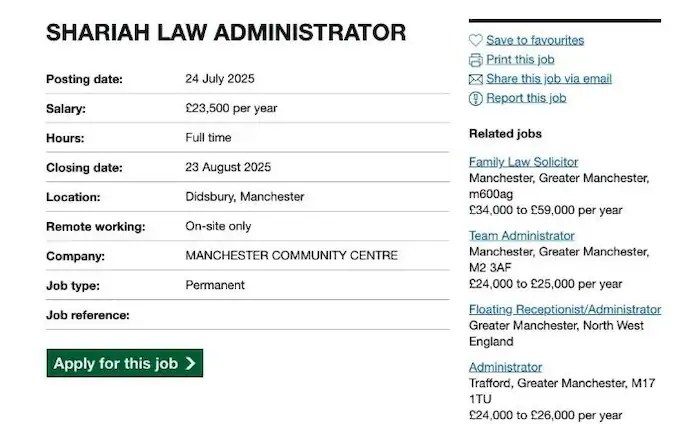
A job posting for a Sharia Law Administrator on the Department for Work and Pensions’ careers board was like a red rag to a bull for Nigel Farage.
To the Reform UK leader, the advert for the £23,500 a year job in the suburb of Didsbury, Manchester, showed “our country and its values are being destroyed.”
w Sharia councils as a fundamental threat to British values Credit: Penelope Barritt / Shutterstock
A job posting for a Sharia Law Administrator on the Department for Work and Pensions’ careers board was like a red rag to a bull for Nigel Farage.
To the Reform UK leader, the advert for the £23,500 a year job in the suburb of Didsbury, Manchester, showed “our country and its values are being destroyed.”
The listing itself said any potential candidates should have previous experience in “Shariah law-related fields and/or Shariah courts in Muslim countries,” alongside expertise in British law.
But Farage was not the only politician outraged. Senior Tories also lined up to criticise the posting, which briefly emerged in July before being deleted. Robert Jenrick, the shadow justice secretary, said at the time: “As I’ve said before, sharia courts should be banned. The only laws are the laws of England and Wales, Scotland and Northern Ireland. It’s as simple as that.”
Ultimately, the job posting turned out to not be for central government but a community organisation advertising using the platform.
However, the furore shone a light on the network of Sharia law courts that have sprung up across Britain in recent decades to deal with disputes within Muslim communities.
Supporters say they are little more than mediation and religious guidance services that work within British law and are no different to other civil mediation bodies, including Catholic tribunals and the Beth Din rabbinical courts used by Orthodox Jews.
Critics, by contrast, view Sharia councils as a fundamental threat to British values – either by undermining liberal principles or even by working in direct opposition to the UK’s state law.
Maryam Namazie, an Iranian-born human rights campaigner from the One Law for All campaign, says: “The problem with Sharia or any religious court is that it relies on laws perceived as divine, which cannot be challenged or questioned.”
Above all, opponents fear Sharia courts effectively operate as a parallel legal system that diverges from British legal norms.
Tice: ‘Sharia courts have no place in Britain’
Critics cite the fact that, unlike the Beth Din courts used in Jewish communities, the vast majority of Britain’s Sharia councils are not signed up to the Arbitration Act of 1996 – meaning there’s little oversight over the way they operate or recourse for when things go wrong.
Sharia councils as a fundamental threat to British values
A job posting for a Sharia Law Administrator on the Department for Work and Pensions’ careers board was like a red rag to a bull for Nigel Farage.
To the Reform UK leader, the advert for the £23,500 a year job in the suburb of Didsbury, Manchester, showed “our country and its values are being destroyed.”
The listing itself said any potential candidates should have previous experience in “Shariah law-related fields and/or Shariah courts in Muslim countries,” alongside expertise in British law.
But Farage was not the only politician outraged. Senior Tories also lined up to criticise the posting, which briefly emerged in July before being deleted. Robert Jenrick, the shadow justice secretary, said at the time: “As I’ve said before, sharia courts should be banned. The only laws are the laws of England and Wales, Scotland and Northern Ireland. It’s as simple as that.”
Ultimately, the job posting turned out to not be for central government but a community organisation advertising using the platform.
However, the furore shone a light on the network of Sharia law courts that have sprung up across Britain in recent decades to deal with disputes within Muslim communities.
Advertisement
Supporters say they are little more than mediation and religious guidance services that work within British law and are no different to other civil mediation bodies, including Catholic tribunals and the Beth Din rabbinical courts used by Orthodox Jews.
Critics, by contrast, view Sharia councils as a fundamental threat to British values – either by undermining liberal principles or even by working in direct opposition to the UK’s state law.
Maryam Namazie, an Iranian-born human rights campaigner from the One Law for All campaign, says: “The problem with Sharia or any religious court is that it relies on laws perceived as divine, which cannot be challenged or questioned.”
Above all, opponents fear Sharia courts effectively operate as a parallel legal system that diverges from British legal norms.
Tice: ‘Sharia courts have no place in Britain’
Critics cite the fact that, unlike the Beth Din courts used in Jewish communities, the vast majority of Britain’s Sharia councils are not signed up to the Arbitration Act of 1996 – meaning there’s little oversight over the way they operate or recourse for when things go wrong.
Advertisement
Richard Tice, the deputy leader of Reform UK, says: “Sharia courts have no place in Britain. We cannot allow a shadow parallel legal system to develop in this country.”
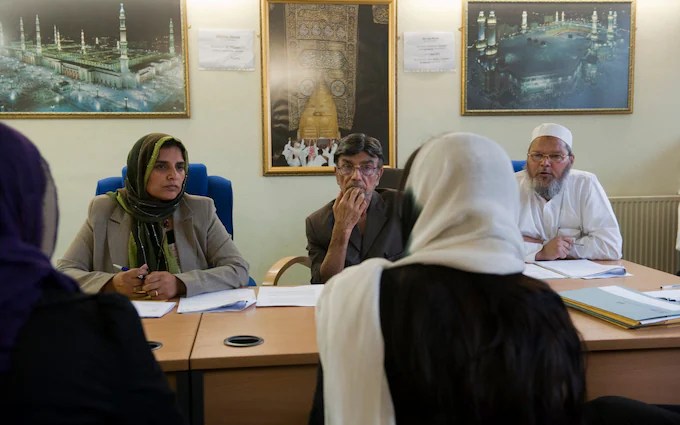
Britain’s first Sharia law court opened its doors in Leyton, east London, in 1982. The unofficial tribunals offer to resolve disputes in line with Islamic legal principles. The councils that exist in the UK vary in size and scale, from individual scholars to more sophisticated bodies supported by professionals including qualified lawyers.
Dozens now exist across the country, with estimates suggesting there are up to 85 in Britain. The religious courts are mostly used for divorces, often when Muslim women want a “Talaq” certificate that allows them to remarry under Islamic law. These tribunals also deal with inheritance disputes or other civil matters.
Sharia councils as a fundamental threat to British values
say they are little more than mediation and religious guidance services that work within British law and are no different to other civil mediation bodies, including Catholic tribunals and the Beth Din rabbinical courts used by Orthodox Jews.
Critics, by contrast, view Sharia councils as a fundamental threat to British values – either by undermining liberal principles or even by working in direct opposition to the UK’s state law.
Maryam Namazie, an Iranian-born human rights campaigner from the One Law for All campaign, says: “The problem with Sharia or any religious court is that it relies on laws perceived as divine, which cannot be challenged or questioned.”
Above all, opponents fear Sharia courts effectively operate as a parallel legal system that diverges from British legal norms.
Tice: ‘Sharia courts have no place in Britain’
Critics cite the fact that, unlike the Beth Din courts used in Jewish communities, the vast majority of Britain’s Sharia councils are not signed up to the Arbitration Act of 1996 – meaning there’s little oversight over the way they operate or recourse for when things go wrong.
Advertisement
Richard Tice, the deputy leader of Reform UK, says: “Sharia courts have no place in Britain. We cannot allow a shadow parallel legal system to develop in this country.”
Britain’s first Sharia law court opened its doors in Leyton, east London, in 1982. The unofficial tribunals offer to resolve disputes in line with Islamic legal principles. The councils that exist in the UK vary in size and scale, from individual scholars to more sophisticated bodies supported by professionals including qualified lawyers.
Dozens now exist across the country, with estimates suggesting there are up to 85 in Britain. The religious courts are mostly used for divorces, often when Muslim women want a “Talaq” certificate that allows them to remarry under Islamic law. These tribunals also deal with inheritance disputes or other civil matters.
As they have grown, so too has their controversy.
“The reason why they’re controversial is twofold,” says Prof Samia Bano, of the School of Oriental and African Studies, who specialises in Islamic family law. “First of all, there is a concern that they are parallel legal systems. Is this Islamic law being practised through the back door in a way which usurps and undermines English family law?
Rahila Gupta, the chairman of Southall Black Sisters, says: “We have consistently campaigned against the entrenchment of parallel religious laws be they sharia courts, Beth Dins or Sikh courts – especially in matters of family law – because their judgments reveal a patriarchal bias against women’s rights and freedoms.”
 Who Watches the Watchers?