
 Posted by
 The Cairo Gang were a notorious British squad whos mission was to break the IRA in Dublin, to unpick the clandestine web that Michael Collins had spun across the city from pubs, shops, and council offices. The Brits called them the Dublin District Special Branch, it was the Dubs that gave them theyre more mythological nickname. Some of the men had indeed served in British intelligence across Egypt and Palestine during the Great War, others were said to haunt the Cairo Café on Grafton Street. They came to Dublin in 1920 with their notebooks and guns. Demobilised officers and a handful of active-duty men. Dipping in and out of rented rooms, sitting behind lace curtains on Baggot Street or leaning over the banisters of anonymous boarding houses. Taking names and discrete photos. The Cairo Gang mostly lived inconspicuously in the field, moving between digs, swapping coded reports, and drawing up a list of republicans marked for death. Collins had his own answer to this challenge. His unit, the notorious Squad, was an assassination team built on loyalty, ruthlessness and speed. They were young, mostly Dublin lads, some scarcely older than the revolution itself. Collins knew that if he allowed the Cairo Gang’s operation to mature, then the IRA’s Dublin network might not survive the winter. War of Indepenance would be lost. Hell was unleashed on the morning of the 21st of November 1920, a date that Dublin would remember simply as Bloody Sunday. Dawn had barely settled over the red brick terraces when IRA teams fanned out across the south inner city. Their goal was not chaos but decapitation, a precise strike meant to collapse British intelligence in a single hour. They raided boarding houses on Pembroke Street, Morehampton Road, and other quiet addresses where the Cairo Gang slept behind closed doors. By the end of the morning fourteen men were neutralised and another would die later. They included intelligence officers, courts martial officers, a Royal Irish Constabulary sergeant, and one civilian tragically caught in the crossfire of history. The impact was immediate. Surviving agents fled to the heavy stone embrace of Dublin Castle. British intelligence operations in the city were effectively paralysed. Collins, for the moment, had secured the upper hand, and his coup reverberated far beyond Dublin’s canals. It was a propaganda triumph. But if the IRA expected their attacks on military targets would inspire a similar retaliation on legitimate IRA combatants they would be mistaken. British “justice” has always involved brutal collective punishment upon civilians. That afternoon, a mixed group of RIC men, Auxiliaries and rabid Tans stormed Croke Park where Dublin and Tipperary were meeting in a challenge match. They opened fire on the crowd without warning and indescriminately. Fourteen civilians were killed, including Tipperary player Michael Hogan, and dozens more were wounded. A sporting field became a bloodbath and public fury swelled in the days that followed. The Cairo Gang vanished from Irish history in that single morning, but the consequences of their elimination carried forward.Without the crippling of British intelligence in 1920, without the growing military and political pressure that followed, it is difficult to imagine London agreeing to negotiate. The Treaty that emerged in December 1921 was shaped by the momentum created during those violent years, and the strike against the Cairo Gang was one of the blows that forced the door open.
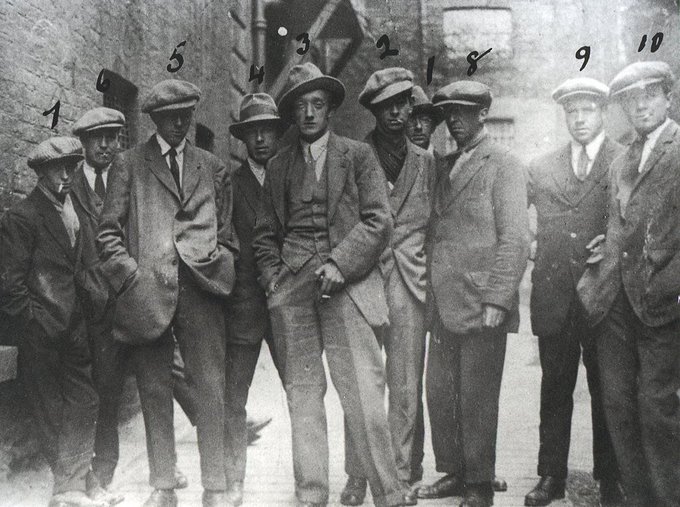
from Dublin City, Ireland
·
40.3K Views
 Who Watches the Watchers?