
 Posted by
 Updated / Tuesday, 17 Mar 2026 17:10
Northern Editor
Former Sinn Féin leader Gerry Adams has told a court hearing in London that he was never a member of the IRA and never sanctioned any bombings in Britain.
He is being sued by three men who allege that he was liable for injuries they suffered in IRA bomb attacks in London and Manchester in 1973 and 1996.
Following evidence from 11 witnesses over five days for the claimants, the former Sinn Féin leader took to the witness box shortly after 10.30am.
He began by wishing the judge and those in the courtroom a “happy St Patrick’s Day”.
He is being sued by Jonathan Ganesh, who was injured in the 1996 London Docklands bombing; John Clark, a victim of the 1973 Old Bailey bombing in London; and Barry Laycock, a victim of the 1996 Arndale shopping centre bombing in Manchester.
The men are suing him for “vindicatory damages” of £1 and seeking a ruling that he is personally liable for injuries they received.
It is the first time a court has been asked to adjudicate on claims that Mr Adams, 77, was a member of the IRA, which he has always denied.
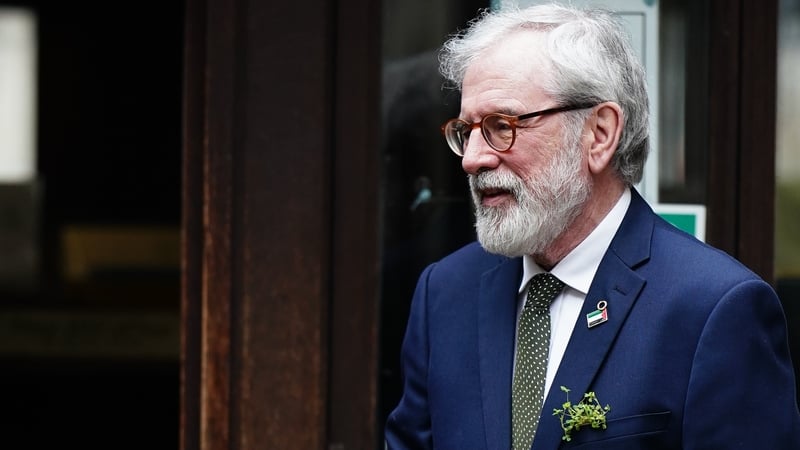
He arrived at court wearing a sprig of shamrock in his lapel and is the only witness being called by his defence.
In a 20-page witness statement, Mr Adams denied the allegations that he was responsible for the 1973 and 1996 bombings at the centre of the case and that he was a senior member of the IRA.
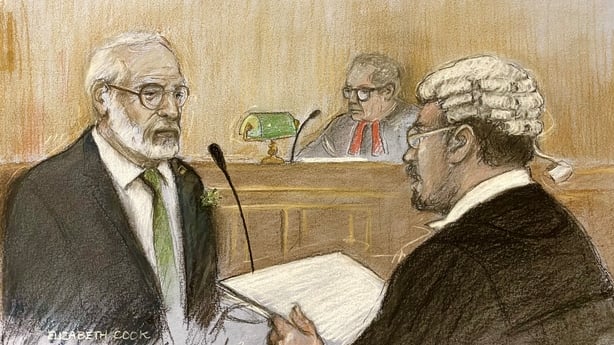
“These allegations are untrue. I was never a member of the IRA or its Army Council. I was never the ‘Commanding Officer’ or ‘OC’ of the 2nd Battalion of the IRA’s ‘Belfast Brigade’,” the statement says.
“Indeed, I have never held any rank or role within the IRA, including on the IRA’s Army Council. I have never held a ‘command-and-control role’ in the IRA and have never been a senior, let alone most senior figure, in the IRA.”
He continued: “I had no involvement in or advance knowledge of the Old Bailey bombing (1973), the Canary Wharf bombing (1996) or the Manchester bombing (1996).
“I have never been charged, prosecuted or convicted of any offence in connection with any of the bombing incidents in which the claimants were injured.”
Mr Adams also said that opponents of Sinn Féin “have repeatedly sought to conflate” the party with the Provisional IRA.
“As I have always stated, Sinn Féin and the IRA are separate organisations,” Mr Adams said.
He continued: “I have no knowledge, beyond what has been widely reported in the public domain, as to the structure or decision-making processes of the IRA.”
Mr Adams told the court that he was “very conscious” that the three bomb victims had “suffered significantly”, and that his statement should not be taken “as criticism of the claimants, or as any attempt to deny or diminish their awful experiences”.
The claimants’ case is that Mr Adams was “directly responsible for and complicit in” what happened to them because he had a leadership role in the IRA at the time of the bombings.
In their opening legal submissions, they say that while there is no doubt that Mr Adams contributed to peace in Northern Ireland, “the claimants say that on the evidence he also contributed to the war”.
During the trial, Mr Adams has been described as the “de facto leader” of the IRA and its “greatest strategic thinker”.
The court has been told that it was “inconceivable” that he would not have been involved in IRA decisions to carry out bomb attacks in Britain because of his membership of the Army Council, which had to authorise such attacks.
Two points on why the case should fail – defence
Mr Adams has always denied ever being a member of the IRA and his legal team say the case against him is built purely on hearsay evidence.
In their opening submission, his lawyers quote the claimants’ solicitor who described the proceedings as “the most serious allegations imaginable”, a claim that he “was directly involved in some of the worst terrorist atrocities in British history for a period of 30 years”.
They say the case should fail on two points.
Firstly, they say the claimants could have brought the claims many years ago and point out that there is a mandatory three-year time limit for initiating civil proceedings in English courts.
The lawyers describe the delay in bringing these claims for IRA bomb attacks in 1973 and 1996 as “exceptional” and “extraordinary”.
As a result, they say “the majority of potential witnesses and alleged protagonists are now dead; relevant documents and records have been lost; and recollections of events that took place decades ago have inevitably faded beyond the point of reliability”.
The lawyers say the delay significantly prejudices Mr Adams’ ability to defend the claim and argue that there is no legal or practical reason why the claims could not have been issued long before 2022.
They say the claims should be dismissed on the basis that they are limitation barred.
Secondly, they argue that the claimants’ evidence does not come close to proving their case against him, the allegation that he was directly responsible for what happened to them.
Given the gravity of the allegations, “the most serious allegations imaginable”, they say there is a heavy burden of proof “which could only be discharged through the presentation of cogent and compelling evidence”.
They said none of the individuals involved in authorising, planning and carrying out the 1973 and 1996 bombings was a witness in the trial, there are no contemporaneous documents, forensic or scientific evidence which implicate Mr Adams in any of the attacks.
The lawyers said that in the absence of any direct witness evidence the claimants were seeking to build a case “on the basis of an assortment of hearsay evidence”.
‘Claimants bear the burden of proof’
They state that “not a single page” of the contents of secret intelligence reports referred to by several witnesses has been disclosed during the proceedings.
Their opening skeleton argument states that the claimants bear the burden of proof for their allegations and that Mr Adams does not have to prove that he was not a member of the IRA.
“The defendant does not bear the onus of proving anything,” the submission adds.
“In particular, he is not required to prove a negative (eg. he is not required to prove that he was never a member of the PIRA and its Army Council, etc).”
Speaking outside the High Court after the second day of the trial last week, Mr Adams said the only thing he was guilty of “is being an Irish republican, is believing in an end to British rule”.
As this is a civil legal action, the burden of proof is “on the balance of probabilities” while the bar in a criminal case is much higher with the burden of proof “beyond a reasonable doubt”.
 Who Watches the Watchers?