
 Posted by
China in the (South Asian) ‘hood
March 27, 2022

Meet the party that runs China
As China faces pressure and criticism from the West for not changing its “neutral” stance despite Vladimir Putin’s actions in Ukraine, Beijing is trying to create space for itself by shoring up old allies and mending fences in its rough neighborhood.
So while US President Joe Biden was doing the rounds in Europe to rally NATO last week, China’s Foreign Minister Wang Yi was on a whirlwind tour of South Asia, making moves that signal how China wants to operate in its own unstable region — even extending an olive branch to its rival, India.
Wang’s itinerary says it all. In Islamabad, he attended the summit of the Organization of Islamic Cooperation hosted by longtime China pal Pakistan, marking the first time China was invited as a guest of the 57-member bloc (Chinese state media heralded the invitation to mean the Islamic world was giving a “clean bill of health for China’s treatment of [Uighur] Muslims” at home). Then, Wang made a surprise visit to Afghanistan, where he met leaders of the new Taliban regime.
Finally, Beijing’s top diplomat landed in New Delhi for his first trip to India since Chinese and Indian troops faced off in a deadly Himalayan skirmish in 2020 (the Indians made it clear that the visit was initiated by China). After attempting to thaw ties with India, he topped off the tour by dropping by Nepal, where China is competing for influence with the US.
Asia watchers see Wang’s South Asian diplomatic hustle as a necessary response to the difficult situation China finds itself in regionally, considering Beijing’s investments and relations aren’t doing too well there.
“I see Wang Yi’s South Asia swing as more of a damage assessment tour,” says Sameer Lalwani, director of Asia Strategy at the Stimson Center.
Ties with India are chilly. China’s $65 billion economic corridor in Pakistan is stalled. Afghanistan still poses a threat. Nepal may be slipping away, and perpetually broke Sri Lanka is looking to Beijing for a bailout.
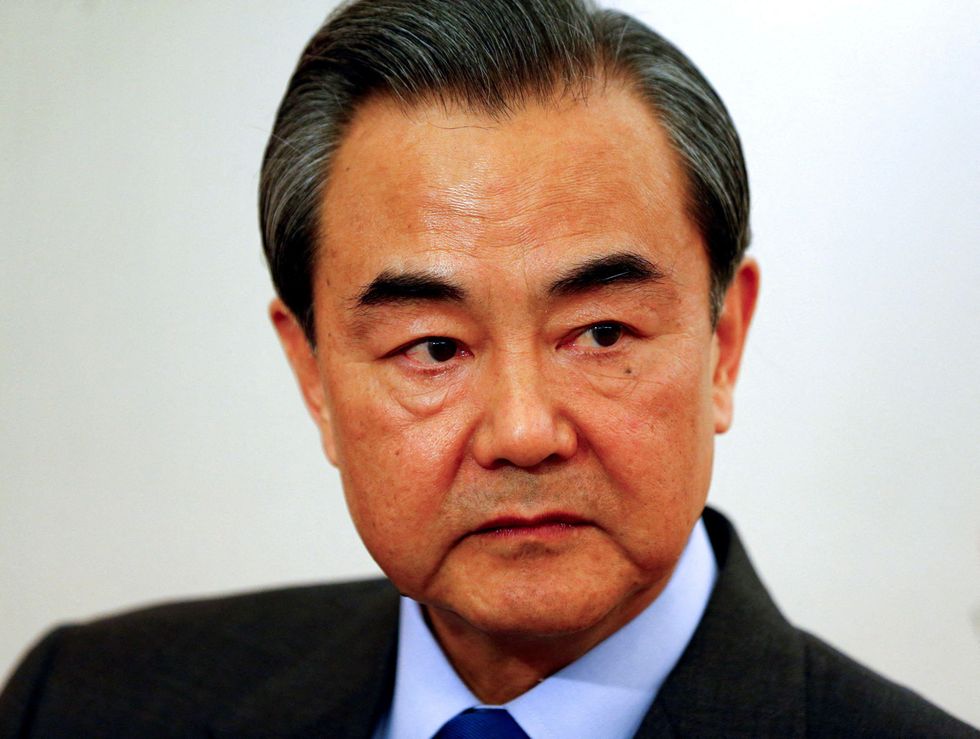
China’s Foreign Minister Wang Yi answers questions during a Reuters interview in Munich, Germany.Reuters
“[Wang’s] visit to Pakistan came as Islamabad is in the throes of yet another political crisis,” Lalwani explains. “His surprise visit to their mutual Taliban partners in Afghanistan allowed him to see firsthand the economic and governance disaster they have become and the security liability they are creating for Beijing.”
Tanvi Madan, head of the India Project at Brookings and author of Fateful Triangle: How China Shaped US-India Relations during the Cold War, sees Wang’s trip within the context of China’s double-trouble moment, globally and locally.
First up is China’s position with regard to the Russia-Ulkraine war, “where it is feeling pressure from several sides about how closely it is backing or seems to be backing Russia,” Madan says. The second aspect, meanwhile, involves China hitting “headwinds for its interests in South Asia as a whole.”
China and India find themselves on the rare same page on Russia. Both New Delhi and Beijing have refused to condemn Moscow, and they continue to deal with Russia despite sanctions. But that’s where the similarities end.
While China is India’s largest trading partner, with bilateral trade hitting the $95 billion mark in 2021-22, trade remains heavily tilted in Beijing’s favor. Also, China has for decades armed and supported Pakistan, India’s archrival.
Since their 2020 military clash, Delhi has been tightening the screws on Chinese companies, banning certain imports and apps. But now, China wants to continue cooperating while setting the border tensions aside.
Beijing has tried to spin Wang’s trip to Delhi as a fence-mending mission. The Foreign Ministry’s handout says “China does not pursue the so-called ‘unipolar Asia’ and respects India’s traditional role in the region,” adding that “if China and India spoke with one voice, the whole world will listen.”
However, wooing India while trying to flex muscle in South Asia isn’t going to be an easy courtship for Beijing. Not in the mood for being a cheap date, New Delhi has indicated that things aren’t going to go back to business as usual unless the border tensions are resolved and China disengages militarily. And as for Wang’s wish that the two countries speak with “one voice,” India’s foreign minister clarified that India had its own points of view about the international order.
Those points of view may converge with China’s on issues like Ukraine (both sides have demanded a cease-fire), but not on other security and trade issues, such as Kashmir, China’s Belt and Road Initiative, or the Quad.
As its South Asian interests and influence grow, China might think of itself as a major player — but India begs to differ. This isn’t China’s ‘hood. Not yet.
“They’re overlapping peripheries. China might consider [South Asia] its ‘hood,” says Madan. “But India has considered South Asia its ‘hood for a lot longer than Beijing has.”
As the humanitarian emergency continues to unfold, our first priority has been the well-being and safety of Mastercard employees and their families. To support the region more broadly, we are mobilizing the breadth of our assets in support of NGOs, governments and financial institutions.
NORTH KOREAnorth korea missile testsgraphic truth
Hard Numbers: Shanghai lockdown, US billionaire tax, Amazonian NFTs, Houthi truce
Biden speaks to Scholz during an EU leaders summit in Brussels.
REUTERS/Wolfgang Rattay
EU signs US gas deal amid Biden’s European trip
US President Joe Biden kicked off his meetings in Europe on Thursday with a few big salvos. Ship more weapons and humanitarian aid to the Ukrainians? Check. Welcome 100,000 Ukrainian refugees to the US? Check. Zoom with Ukrainian President Volodymyr Zelensky? Of course. Biden also said Russia should be booted from the G20, a grouping of the world’s largest economies, ahead of a summit later this year in Indonesia.
The G-7 countries and the EU leveled new sanctions on Thursday against more than 400 Russians, including members of the Russian legislature. But the allies still aren’t giving Zelensky what he really wants: a NATO-enforced no-fly zone to let civilians escape Russian attacks.
More
ian bremmerpandemiccovid-19 small businesseseventglobal economypandemic recoveryworkplace culture
Subscribe to GZERO Media’s newsletter, Signal
Today In 60 Seconds
SCOTUS confirmation hearings no longer serve a purpose
Biden’s Europe trip to show strengthened alliance against Russia
European support for Ukraine remains strong ahead of Biden’s visit
Watching Russia: cyber threats & disinformation
Zelensky plea for additional Ukraine support puts US in a bind
GZEROMEDIA
Subscribe to GZERO Media’s newsletter: Signal
Latest
China in the (South Asian) ‘hood
13h
Iran nuclear deal 2.0, or war?
March 28, 2022
What We’re Watching: Biden “gaffe” fallout, Russia changes war plan, Pakistani political turmoil
March 27, 2022
Ukraine: Who wins a stalemate?
March 24, 2022
The Graphic Truth: North Korea’s missile menu
March 27, 2022
Hard Numbers: Shanghai lockdown, US billionaire tax, Amazonian NFTs, Houthi truce
March 27, 2022
What We’re Watching: US-EU gas deal, Putin’s ruble ruse, China-India meeting
March 24, 2022
Ian Bremmer: COVID made us rethink labor
Coronavirus
March 26, 2022
Podcast: Iran on the verge: why you don’t want the nuclear deal to fail, according to Iran expert Ali Vaez
26 March
Want small businesses to succeed? Enable them as problem-solvers
Coronavirus
25 March
 Who Watches the Watchers?